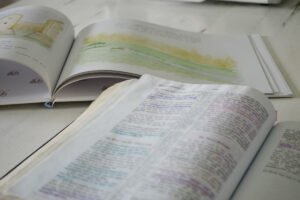
This summer, I put myself in a crunch. Between finishing up homeschool, childcare, preparing for markets for both Apologia and my own business, on top of everyday life things, I arrived at the second week of June physically, mentally, and emotionally worn out, knowing I still had a summer Bible study to prepare and write.
In May, I finished homeschooling my middle niece; she will be off to full-time kindergarten in August, and her older sister will be starting second grade. During each of their two years of preschool, one of the main focuses was what I called “Bible-time.” During the summer, we continue Bible-time, just on a smaller, more relaxed scale. Last summer we went through the wisdom books, with the help of a kids’ story Bible, and I asked them the same questions each day. This summer, we went through the study I wrote for Apologia, but they were my guinea pigs because I was writing it as we went. If questions failed with them, I rewrote them. If there was something they struggled to comprehend (mostly because I was explaining it poorly or expecting them to understand something too abstract, they are only 7 and 5 after all), I either repositioned the concept to the older age-group, or I found a way to make it less abstract (hence, some of the visuals that were included, particularly the hand motions for talking about the covenants).
I think whenever we have a plan for something we are going to do with kiddos, we have a picture in our heads of how it will go, and in my experience, it rarely goes that way for one reason or another.
I thought I would write this month’s article as a brief reflection on the last few months, most particularly the study.
My original goal for the study was to write something simple that could span a broad age range and be easy for parents to navigate each week. I did not want it to be overwhelming or too bulky, yet I wanted it to be theologically rich.
As I prepared to write the study on one topic, I realized I was putting myself in a position to be utterly overwhelmed if I moved forward with it. I pivoted and decided that a study about how Christ is in the whole of the Bible would align better with the intent of the study. As I began writing, I found that this, too, was not quite so simple. There are so many things we could have gotten into this summer, and within each of those things, there are so many layers of richness to study. I had to continually rein myself in from going down what some may call rabbit trails, but truthfully, all connect to the content of the various weeks of study. I also had to remind myself that it is actually not necessarily beneficial for me to give people every answer and all the information, and that their own exploration of the text and study of God’s Word is important.
In our first week, Christ in Creation, we saw how Jesus was present and the plan right from the beginning. In our second and third weeks, we saw how God made covenants with people and nations to restore relationship between Himself and them, always pointing forward to the ultimate and final Restorer, Jesus. In our fourth week, we saw how the Day of Atonement foreshadowed Christ’s substitutionary atonement. In our fifth week, we saw how Christ is pictured in the manna in the wilderness and how He is the true bread from heaven. And finally, in our sixth week, we saw how Christ was both the promised Prophet and the subject of the promises the prophets communicated on behalf of God.
As I studied and prepared to write, I learned some things I didn’t know. Mostly, I found my understanding being deepened and refreshed. Oftentimes, writing something like this or preparing to teach something helps me learn the subject more thoroughly. It is one of the gifts of doing so. I hope that any of you who went through this study with us this summer found the same to be true as you prepared for the time with your kids. I hope that your hearts and minds were refreshed and challenged. I hope that your hunger to study God’s Word and know Him through it was strengthened. And I hope that you saw Christ and His everlasting, enduring love for you.
May the grace of Christ be with you,

Share this:
- Share on Facebook (Opens in new window) Facebook
- Share on X (Opens in new window) X
- Print (Opens in new window) Print
- Share on Pinterest (Opens in new window) Pinterest
- Share on LinkedIn (Opens in new window) LinkedIn
- Email a link to a friend (Opens in new window) Email
- Share on Threads (Opens in new window) Threads
Discover more from Apologia Publishing
Subscribe to get the latest posts sent to your email.