On this last day of August, with Labor Day next week, school has resumed for most children, marking the unofficial end of summer.
These days, the options available for educating your children are wide-ranging. When choosing a path, several factors, including social, economic, and religious factors, must be thoughtfully weighed. With the ever-increasing corruption of culture and many prominent faith leaders calling for Christian parents to remove their children from the public school system, there are certainly a lot of education models to choose from. However, I am particularly sensitive to parents who are limited by finances or by a spouse who isn’t on board with an alternative, as was the case for me. Whatever educational path you have willingly decided on, or perhaps resigned yourself to, creating a home environment where communication is encouraged is vital.
In 2000, my husband and I were looking for a new home to purchase. With a toddler and a second child on the way, we were quickly outgrowing our little townhouse. I hoped to stay in our current city; it was a rapidly growing, relatively conservative town with an excellent public school system. One day, I lamented to my sister during a phone call about the difficulty of finding a home in our price-range. We could afford a bigger house in a neighboring town, but the school district wasn’t as strong. My sister, who was homeschooling her children, bluntly responded, “Well, public school is a difficult mission field for your children.” I was frustrated by her tone and lack of support, though I knew that she was simply concerned about the future spiritual welfare of my children. Although I was a stay-at-home mom capable of educating our children, my husband simply wasn’t on board. Twenty-five years ago, the thought of homeschooling was still very new to us, and for him, it conjured up the stereotypical images of socially awkward children. “Besides,” he insisted, “we turned out okay.”
I could have resisted, but, instead, when the time came to enroll our first child in the local kindergarten, I determined to involve myself in what my kids heard, learned, and viewed as much as possible. For the things that were beyond my control, such as inappropriate things they learned on the bus or playground, I prayed for wisdom and addressed them immediately. Perhaps it sounds as if I was a helicopter mom; I was not. I simply asked my kids questions about their school day, every day. I listened as they shared. I didn’t outwardly balk at things that they learned from their “friends” (though I sometimes did inwardly). I talked through things without them fearing they would be punished for sharing. I gained their trust. No topic was off the table. Communication was prioritized.
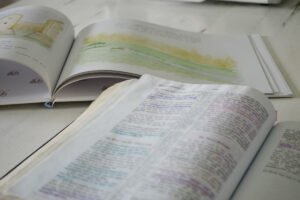
My husband and I also lived out our faith. For the entirety of their lives, our boys have witnessed us reading or studying our Bibles, praying, and leaning heavily on the Lord during difficult times. They watched their father coach a local public high school soccer team for 29 years where he courageously shared his faith (it’s amazing he wasn’t fired!). I taught Sunday school, worked part-time for a church for a few years, and have written and led Bible studies. A Bible is almost always lying open on our dining table. We lived in the world but did our best not to be of the world.
In many ways, sending our boys to public school made it easier to explain to them the differences between secular and Christian worldviews, especially when they watched their peers make unwise choices. In a public school where a majority of students have no relationship with Christ, our boys had a choice: they could choose to follow the world and suffer the consequences, or they could choose to be lights in the darkness. The contrast from Scripture was relevant for teachable moments, though their choice was not always easily made.
In retrospect, I giggle as I recall some of the conversations we had as they grew up in the public school system. These conversations, however, could have been prompted by events in any school setting–public, private, or otherwise–as fallible humans participate in life together. They include:
- Consoling my then second grader when he was sent to the principal’s office for defending God to a Hindu classmate and making her cry after she engaged him in a debate at the lunch table about whose deity was better.
- Agreeing with my then fourth grader when he told me that French people were gross because a classmate had explained the act of French kissing to him.
- Explaining the female reproductive system to my then fifth grader after he told me he called someone a name that referred to a device for cleansing out a female body cavity (I don’t think he ever said it again).
- Explaining reproduction to my then extremely curious middle schooler on the turf of an indoor soccer field while his brother was playing in a game. (He would go on to include this conversation in his personal statement for med school!)
- Explaining to my then high school senior that there was a better way to express his opinions after he was kicked out of student government for joining a group chat for the sole purpose of sharing a SpongeBob comic exclaiming, “There are only two genders!” and then leaving the chat.
I am certain that it is by God’s grace that my boys came out of the public school system with their faith relatively unscathed. Certainly, they were challenged, and one of them will tell you that he was bullied for adhering to his Christian beliefs, but all four of them are stronger as a result. Mistakes were certainly made on both ends, but I’m convinced that creating a home welcoming awkward and difficult discussions and giving biblical answers was essential for getting through those years. In our current cultural landscape where information is available to them at the touch of a button, it is even more so.
If you send your children to a public school, prepare yourself now for the days when you’ll need to address something introduced to them that is contrary to your family’s Christian belief system. Whether it comes from a fellow student, teacher, or coach, it is inevitable. As culture pushes the acceptance of alternative lifestyles, equity (not equality) of justice, and other anti-Christian positions, public schools are generally accepting these ideologies and may even be integrating them into their curriculum. Christian children will be confronted with these anti-Christian positions throughout their public school education.
If you send your children to private Christian schools, they are not immune to influences that are contrary to orthodox Christianity. There are many non-Christian parents who choose to send their children to private schools simply for the smaller student-to-teacher ratio and rigorous academics; their secular beliefs and behaviors often follow them. But there is another danger lurking within the private school model called Moral Therapeutic Deism. People who unknowingly subscribe to this philosophy believe being a good person and treating others fairly makes them a Christian. They believe Jesus was the perfect, moral example but lack understanding of Jesus’ atoning sacrifice. Moral Therapeutic Deism muddies the clear truth found in Scripture and has the propensity to confuse young Christians, especially when they witness their “good” friends willingly make worldly choices.
If you homeschool your children, you are not without your own set of challenges. Many homeschool parents feel inadequately equipped to educate their children and balance their time between teaching and assisting multiple children at various stages of learning while maintaining a home. Many often experience feelings of isolation or burnout. And, while homeschooling is far more appealing for shielding children from the increasing corruption of the culture, the risks are not completely absent when socializing them with other children.
Regardless of the educational model your children are currently in, creating opportunities for daily communication is imperative to help your children learn to navigate their faith in a world full of confusion. Build trust with your children. Help them to feel comfortable with uncomfortable conversations. Be an example to them. Most of all, keep your Bible open, be ready to share Truth with them, and always pray for them.
They are worth it!

Featured photograph by Noah Kelly.
Share this:
- Share on Facebook (Opens in new window) Facebook
- Share on X (Opens in new window) X
- Print (Opens in new window) Print
- Share on Pinterest (Opens in new window) Pinterest
- Share on LinkedIn (Opens in new window) LinkedIn
- Email a link to a friend (Opens in new window) Email
- Share on Threads (Opens in new window) Threads
Discover more from Apologia Publishing
Subscribe to get the latest posts sent to your email.